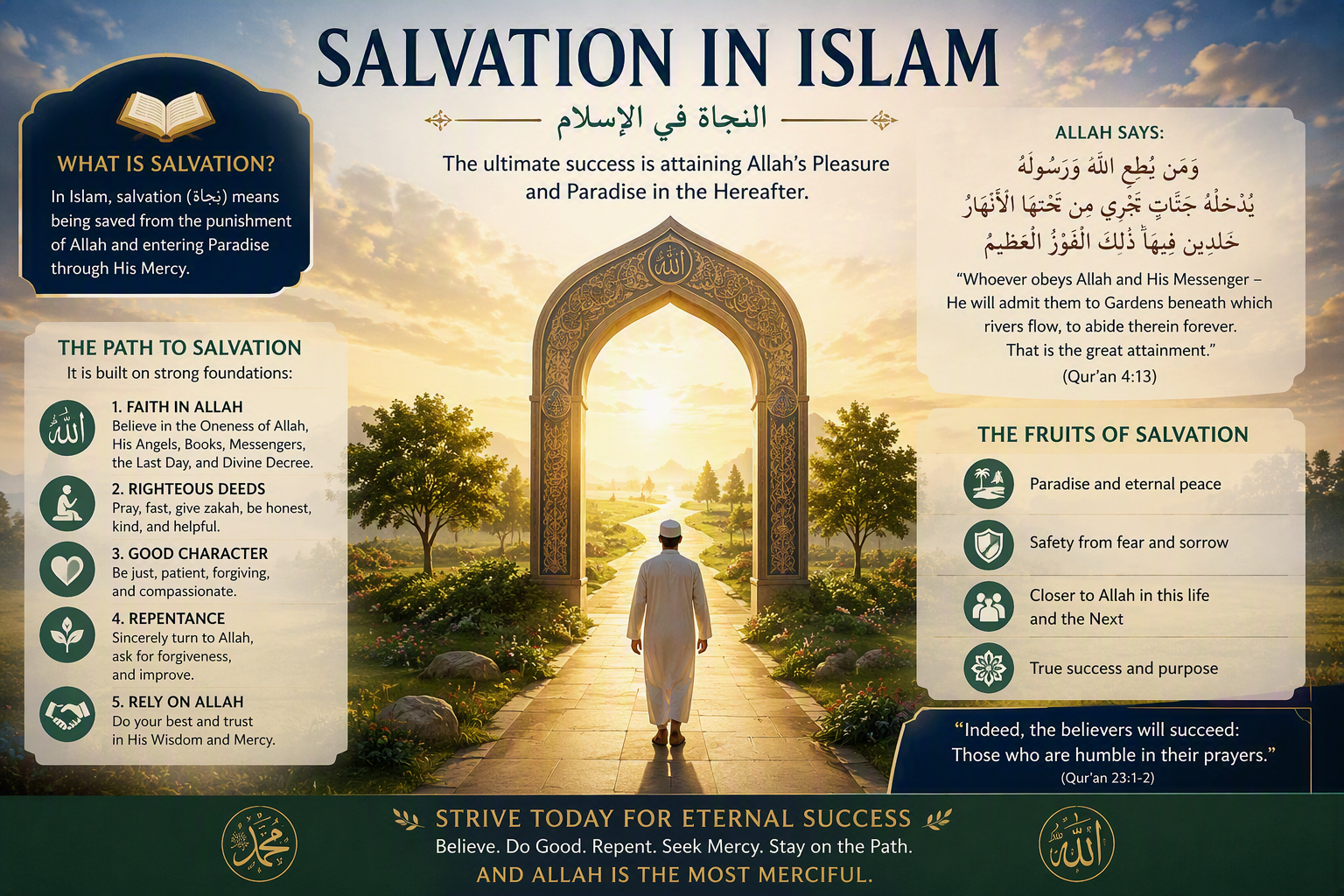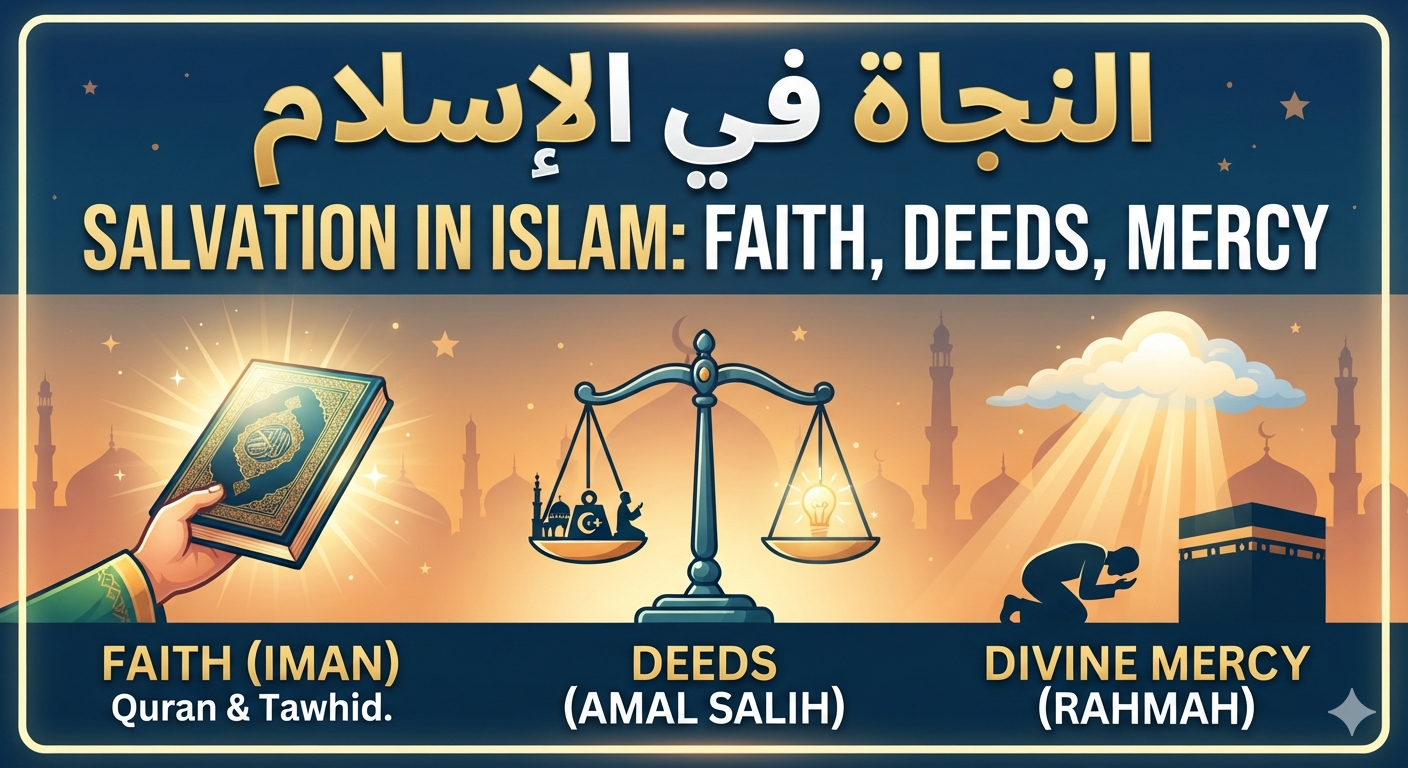
In Islamic theology, salvation is not a one-time event or a guaranteed state of being. Instead, it is a lifelong spiritual journey. The Quran defines ultimate salvation (Falah) as being rescued from the punishments of Hellfire and granted eternal entry into Paradise (Jannah). As stated in Quran 3:185, “Whoever is removed from the Fire and admitted to Paradise has attained [his desire].” This state is achieved through a delicate balance of sincere belief, righteous actions, and the ultimate grace of Allah.
1. The Foundation: Absolute Monotheism (Tawhid)
The absolute prerequisite for salvation in Islam is Tawhid, the uncompromising belief in the Oneness of Allah.
- Direct Relationship: Muslims worship Allah directly without saints, priests, or holy intermediaries.
- The Core Creed: True faith begins with the Shahada, confirming the testimony of faith found in verses like Quran 47:19: “Know, therefore, that there is no Allah but Allah.”
- The Ultimate Sin: Associating partners with Allah (Shirk) is considered the gravest transgression. Allah explicitly warns in Quran 4:48, “Indeed, Allah does not forgive association with Him, but He forgives what is less than that for whom He wills.”
2. Accountability and the Rejection of Original Sin
Islam rejects the concept of inherited guilt or original sin.
- Born Pure: Every human is born in a state of natural purity (Fitrah), a concept highlighted in Quran 30:30, which describes the natural disposition upon which Allah created mankind.
- Individual Burden: No one can bear the spiritual burden of another. As declared in Quran 35:18, “And no bearer of burdens will bear the burden of another.”
- Age of Accountability: Individuals only become accountable for their deeds once they reach spiritual maturity, reflecting the Quranic principle in Quran 2:286 that “Allah does not charge a soul except [with that within] its capacity.”
3. The Divine Equation: Faith and Righteous Deeds
The Quran rarely mentions faith (Iman) without immediately coupling it with righteous deeds (Amal Salih). This inseparable link is famously stated in Quran 103:2-3: “Indeed, mankind is in loss, Except for those who have believed and done righteous deeds.”
- The Five Pillars: Fulfilling obligations like daily prayer and charity forms the baseline of obedience.
- The Scales of Justice: On the Day of Judgment, every individual’s actions will be weighed. Quran 101:6-7 notes, “Then as for one whose scales are heavy [with good deeds], he will be in a pleasant life.”
- Intentions Matter: Actions are judged by sincerity. This mirrors the spiritual warning in Quran 107:4-6 against those who pray only to be seen by people, rather than for Allah.
4. The Supreme Role of Divine Mercy (Rahmah)
While good deeds are mandatory, Islamic text emphasizes that human actions alone are insufficient to “earn” a place in Paradise.
- The Prophet’s Guidance: Prophet Muhammad explicitly taught his companions in the holy traditions (Sahih al-Bukhari 5673) that no one enters Paradise by their deeds alone, but rather through Allah’s encompassing mercy.
- A Loving Creator: Allah’s mercy precedes His wrath. Allah reminds humanity of His boundless grace in Quran 39:53: “O My servants who have transgressed against themselves [by sinning], do not despair of the mercy of Allah. Indeed, Allah forgives all sins.”
5. The Door of Repentance (Tawbah)
Because humans are inherently imperfect, Islam provides a continuous mechanism for spiritual renewal through Tawbah (repentance).
- Direct Access: Forgiveness requires no human confession. Believers turn directly to their Creator, as commanded in Quran 66:8: “O you who have believed, repent to Allah with sincere repentance.”
- Conditions of Repentance: True repentance requires genuine remorse, stopping the sin immediately, and resolving never to return to it.
- Wiping the Slate Clean: Sincerely repenting can completely transform a person’s record. Quran 25:70 states that for those who repent and do righteous work, “Allah will replace their evil deeds with good.”